Monday, June 22, 2009

Art Classes


Art classes seem to be mostly nonexistent in Pokuase.

I bring along donated crayons, markers, colored pencils, stickers, etc., etc. On the first trip I brought a ream of paper, but surprisingly enough, it was easy to purchase paper in Pokuase. I taught a few of the older kids to make simple stitched pamphlet books. We made enough for every kid in the neighborhood.

Every child and teenager was welcome at our twice-weekly classes. Each one received a blank book and some writing / drawing supplies. These were returned at the end of each class, to be retrieved the next time they attended.

Word spread, and our classroom was always full.

My plan for distribution of all the supplies on the last day usually ended in bedlam. And I thought it would be simple to just give it all away….

Prince and His Car


Prince is a born craftsboy. You need to guard your flip-flops and other assorted possessions that could become the raw materials for one of his car creations.


I offered him a trade: art supplies and small tools for one of his cars. This car, in the photo, is made of tin cans with flip-flops for wheels. It now resides on the mantel in my living room.

Field Trips


Pokuase is located about an hour north of Accra, the capital of Ghana. Accra is on the sea. Most of the Pokuase kids have never been to Accra, and have never seen the sea.

On each of my trips to Ghana, I choose three of the older kids, those who have been the most helpful, and take them to Accra on one Saturday. We have a deal. I pay for the tro-tro (public transportation) and give them each 3 Ghana cedis – worth about $2.50. They can do whatever they want with their money – save it, spend it, buy food or water. They cannot ask me for anything else.

This has worked. 3 Ghana cedis is more money than they have ever had at once. On one trip, we visited the sea, and ended up touring the football (soccer) stadium. It is a very special treat – for them and for me. How wonderful to have the opportunity to introduce them to their own country.

Wednesday, June 17, 2009

Pokuase, August 2008


I was back! I was greeted by hugs and cheers and dusty children.


The women had been practicing. They met every Thursday and Friday, and crocheted over 100 bags. They were not all wonderful, but it was impressive and they were proud.


While I was there, we designed our first official KamiAmi bag – called MamiAkua. It is a double-handled oval bag, crocheted of the ubiquitous black rubbers and an accent color from the recycled bags I bring from the US. All of the KamiAmi Women can now make this bag, the exact size, with good quality. And they can make many of them.


We started marketing. We traveled to Accra and put out bags in galleries, and we set up our first exhibition for the visiting university business students. By Ghanaian standards, it was a roaring success.

The KamiAmi Classroom


Our classroom is an open air building on a family compound near the center of town. (My understanding is that) the floor was started and then abandoned. WomensTrust later put up the walls and the roof.


It is a busy place, particularly when schools are closed. Children and chickens are always walking through. Many women come by, selling their goods from their heads: palm wine, prepared food, batiked fabric, kitchen utensils. You name it. Just sitting in the room, watching life pass by, is an incredible experience.


One area just outside our classroom is an open-air church. The praying is done in a language I don’t understand; the singing is quite beautiful. They meet two or three times a week, and once joined us in the midst of a downpour. They seemed to be most welcome in our very crowded room.

Friday, June 5, 2009

Readers beware


Readers beware!

These stories and tales are seen through my eyes, the eyes of a westerner.

I am a visitor to a different culture. It is not always easy to understand or to translate anything that is happening around you. You do the best you can, and then you trust....

Poverty is relative


Poverty is relative, even in Pokuase. At first glance, almost everyone seems poor. Most homes are one or possibly two rooms, in need of paint, with no electricity or running water. If you can see beyond this lack of amenities, there is a kind of wealth that is often unfamiliar to us. It is a social wealth: people connecting to people, people caring about people, people sharing their lives. If you are lucky, you are surrounded by your family and friends, and you are able to say you have enough.


Not everyone has enough. Some people drink polluted water because they cannot afford to buy clean water. Many people eat primarily carbohydrates, because it cheaply fills their bellies and the bellies of their children. Many children cannot go to school, because their families cannot afford the costs of fess, uniforms, and books.


This is why there are so many of us there – trying to somehow make a difference in this cycle of poverty.

Followers

About Me

My photo
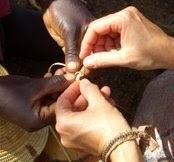
Hands photo by Dani Abrams